Tested with: KSA Version 2026.10.19.5638
¶ Coordinates and Units
Because KSA is a realistic spaceflight simulator, units and coordinate systems matter a lot.
This page documents:
- The base unit system
- Coordinate conventions
- Reference frames
- Special considerations for orbital mechanics
¶ Base Units
KSA uses a standard physics unit system:
- Length: meters
- Time: seconds
- Mass: kilograms
All position, velocity, acceleration, and force values throughout the simulation are expressed using these base units.
¶ Coordinate Conventions
¶ Handedness
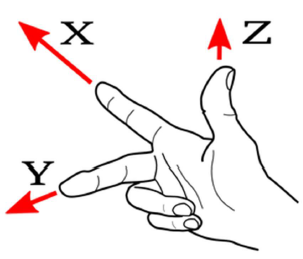
All coordinate frames in KSA are right-handed.
This applies universally: global, local, orbital, and body-fixed frames.
¶ Vector Naming
Vectors are suffixed with the frame in which they are expressed:
positionCceis position in Celestial-Centered EclipticvelocityCcfis velocity in Celestial-Centered, Celestial-Fixed
¶ Rotation Naming
Frame rotations use the notation X2Y to denote a passive rotation taking vectors from frame X into frame Y. Examples:
cci2Ccfis inertial → celestial-fixedorb2Cceis orbital → ecliptic
Active vector rotations are also suffixed:
jointAngleBodyis rotation expressed in the vehicle’s body frame
¶ Inertial vs Non-Inertial Frames
- Inertial frames are non-accelerating and non-rotating; ideal for describing motion.
- Non-inertial frames rotate or accelerate, producing fictitious forces (centrifugal, Coriolis, etc.). These include frames fixed to rotating planets or thrusting vehicles.
¶ Reference Frames
Below is a summary of all major coordinate frames used in the simulation.
¶ ECL: Ecliptic Frame
The global “world” frame used for rendering and for comparing orientations throughout the system.
Identical to CCE and CCI when centered on the sun.
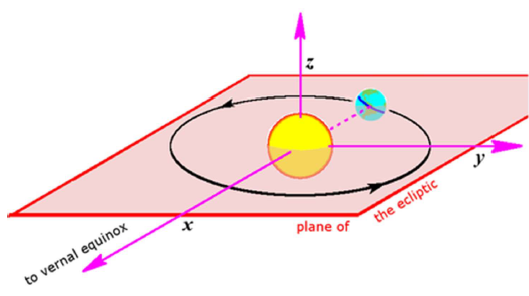
- Type: Inertial
- Origin: Center of the solar system
- X: Direction of periapsis for a zero-inclination/zero-argument solar orbit
- Y: Completes the frame
- Z: Up direction; perpendicular to ecliptic
¶ CCF: Celestial-Centered, Celestial-Fixed Frame
A surface-fixed rotating frame used for surface-relative calculations.
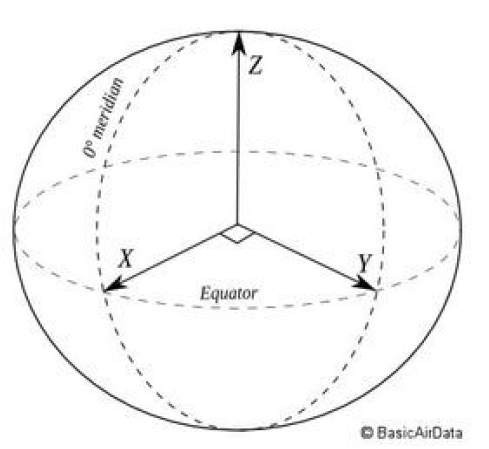
- Type: Non-inertial
- Origin: Celestial center
- X: Equator–prime meridian intersection
- Y: Completes the frame
- Z: Celestial north pole
¶ CCI: Celestial-Centered Inertial Frame
Used for orbital simulation around a celestial.
Axes remain inertially fixed with respect to the ecliptic.
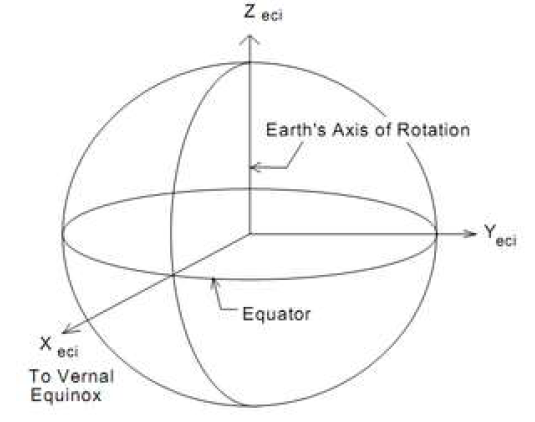
- Type: Inertial
- Origin: Celestial center
- X: Periapsis direction for zero-inclination orbits
- Y: Completes the frame
- Z: Celestial rotation axis
¶ CCE: Celestial-Centered Ecliptic Frame
Shares the celestial’s origin but uses global ecliptic axes.
Useful for cross-celestial orientation comparisons.
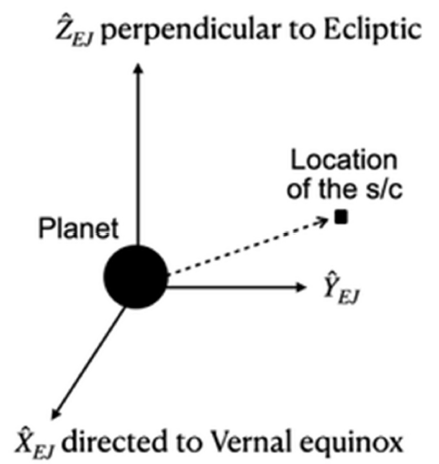
- Type: Inertial
- Origin: Celestial center
- X/Y/Z: Identical to ECL axes
¶ ORB: Orbit Frame (Perifocal)
Defines the orbital plane of a spacecraft or celestial. Commonly used in Keplerian element conversions.
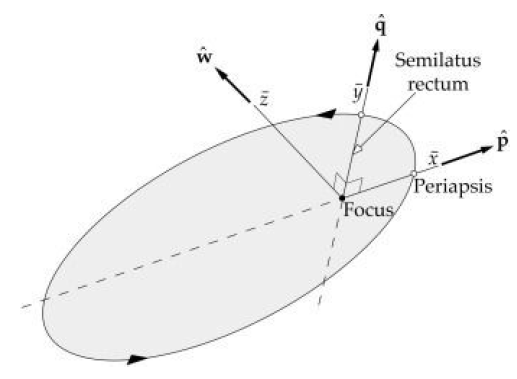
- Type: Inertial
- Origin: Orbital focus (celestial center)
- X: Toward periapsis
- Y: Completes the frame
- Z: Orbital angular momentum direction
¶ LVLH: Local Vertical / Local Horizontal
Useful for spacecraft attitude control.
Provides intuitive axes (down, forward, etc.) for a vehicle in orbit.
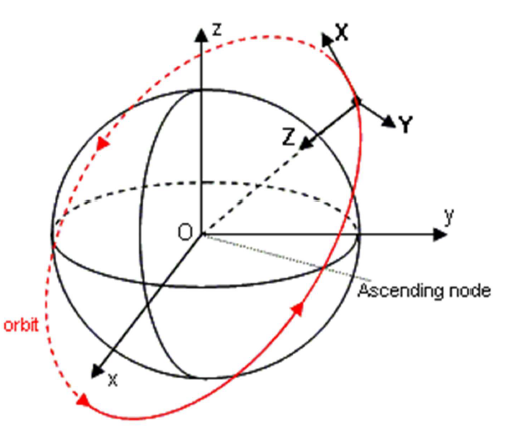
- Type: Non-inertial
- Origin: Celestial center
- Z: Toward celestial center
- Y: Opposite orbital angular momentum
- X: Completes the frame
¶ VLF: Velocity Frame
Designed for maneuver planning using prograde/normal/radial axes.
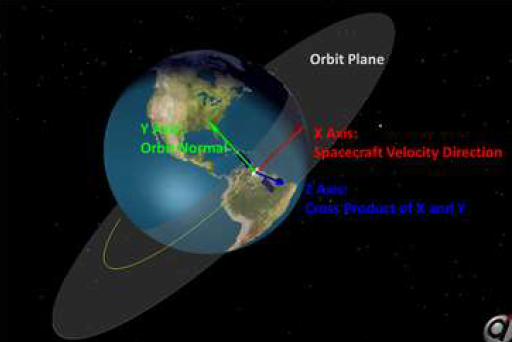
- Type: Non-inertial
- Origin: Celestial center
- X: Prograde
- Y: Normal
- Z: Radial (completes the frame)
¶ BODY: Vehicle Body Frame
Fixed to the spacecraft geometry. Defines roll, pitch, and yaw axes.
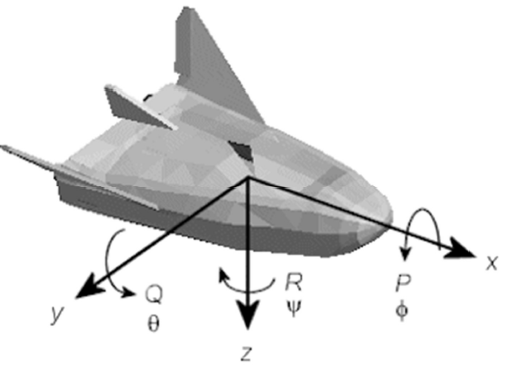
- Type: Non-inertial
- Origin: Vehicle structural origin
- X: Forward / nose direction (roll axis)
- Y: Pitch axis
- Z: Downward / yaw axis
¶ AERO: Aerodynamic Frame
Used for computing aerodynamic forces.
Aligns X with the relative wind direction.
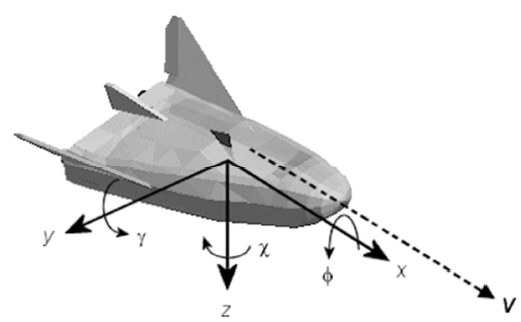
- Type: Non-inertial
- Origin: Object center of mass
- X: Into the relative wind (drag axis)
- Y: Completes the frame
- Z: Toward parent celestial